
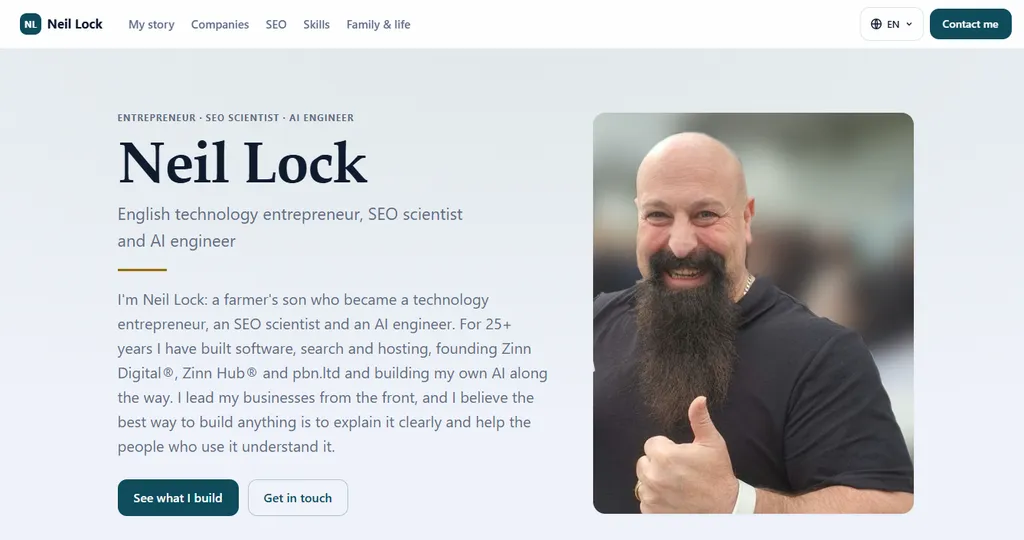
Technology Entrepreneur Neil Lock: ‘Being Neurodivergent Is My Superpower’
Technology entrepreneur Neil Lock is speaking publicly about how being neurodivergent has shaped the way he thinks, works and has built his career.
Neil Lockhas worked in technology for more than 25 years, having turned an early fascination with computers into a career spanning software development, SEO, hosting infrastructure, automation and artificial intelligence.
He is the founder behind Zinn Digital, Zinn Hub and pbn.ltd, with his businesses collectively involved in hosting more than 700,000 websites. His other software includes, among other tools, the WordPress products Tranzly, Page Builder Sandwich, Zinn Chat, Zinn Cache and Zinn Translate.
“I’ve always been obsessed with understanding how things work,” he says. “If something doesn’t make sense to me, I need to pull it apart and understand what’s happening underneath.”
That curiosity began at an early age, with computers including the Commodore 64 and ZX Spectrum. What started as an intense fascination with technology eventually became a career in which Neil Lock could turn that curiosity into something practical: building software, investigating systems and solving problems.
“When I’m interested in something, I can become completely absorbed in it.”
That ability to concentrate deeply has become a defining part of Lock’s working life. When something captures his interest, he can spend hours investigating it, following connections and looking for an answer.
Sometimes, the problem continues to occupy his mind even when he is no longer consciously working on it.
“That determination does not switch off at night. When a problem is urgent, I simply cannot sleep until it is solved; my mind will not let it go. When it is a more general puzzle, a piece of code, a pattern or the shape of a solution, my mind carries on working while I sleep. I often wake up with the answer already there, and sometimes I see it in a dream, which I think is pretty cool. My brain never really switches off, and whatever the hour, I do not stop until a customer's problem is fixed.”
For Lock, this way of thinking has been particularly important in his approach to SEO.
He has worked in SEO since the early days of Google, approaching the subject as something to investigate rather than simply a marketing technique.
His work involves studying search-engine patents, conducting tests, analysing patterns and trying to understand why search systems behave the way they do.
Rather than simply accepting conventional SEO wisdom, Lock has tended to question how things actually work.
That investigative approach has seen him work across thousands of niches and multiple languages, continually testing ideas and looking for patterns in search behaviour.
"I have ranked sites across thousands of niches and in many languages, for my own businesses and for clients."
The same curiosity has followed him into artificial intelligence.
Lock continues to build much of the technology behind his own businesses himself, including software, plugins, packages, applications, automation systems and AI technologies.
His work now spans AI, SEO, hosting and software development, with technology increasingly being used to automate processes that would traditionally require people to carry them out manually.
But there is another side to being able to focus so intensely.
Lock acknowledges that the same characteristics that allow him to become deeply absorbed in a technical problem can also make other situations difficult.
Interruptions can break his concentration. Switching rapidly between different tasks can be challenging. Competing demands can become overwhelming, particularly when his attention is already fixed on something he is trying to solve.
There can also be a tendency to process information differently from the people around him.
For Lock, conventional working environments have not always been an easy fit. The expectation to constantly switch between tasks, respond to interruptions and work in ways that do not necessarily match his natural thought processes can create challenges.
Entrepreneurship eventually gave him something that a conventional career could not: the ability to build his working environment around himself.
Instead of trying to fit himself into a predefined role, Lock could create businesses that allowed him to spend much of his time doing what came naturally — investigating problems, spotting patterns, writing code, building systems and following an idea until he understood it.
“I like to be at the front of my own businesses, not hiding in the shadows while other people do the work. I would rather be the one who explains how something works, and helps people understand it.”
He does not describe ADHD and autism as something that has simply made his life easier, nor does he suggest that being neurodivergent automatically makes someone better at technology or entrepreneurship.
But Lock has gradually learned that he does not necessarily have to fight those characteristics.
He can build around them.
For Lock, that decision is about more than explaining his own career.
He hopes that being open about his experiences can help other neurodivergent people recognise that the characteristics that make some environments difficult do not necessarily have to prevent them from building successful careers.
"Understanding how your brain works can be the beginning of understanding what kind of environment allows you to work at your best." - Neil Lock